

Getty Images
North America’s bid to host the 2026 Fifa World Cup had the working title of ‘United 2026’, promising to unify the continent through a love of soccer and deliver an unprecedented financial windfall.
More than nine years after the idea was first pitched, the first part of that vision is coming to fruition. This is the biggest World Cup of all time, with three countries, 48 teams and 104 matches. This means more broadcast revenue, more sponsorship opportunities and more matchday income.
But, on the eve of the opening game, the build-up to the tournament has proved to be anything but ‘united’.
Domestic politics, international tensions, ticket pricing, climate issues, transport rows and a potential broadcast blackout have all threatened to overshadow soccer’s global showpiece.
Yet soccer’s global popularity means hundreds of millions of people around the world will follow the tournament in-person, through live broadcasts, or on social media. The World Cup remains the biggest show in town and a money-making machine.

Fifa is aiming for its most lucrative World Cup ever, by expanding the tournament to three host countries and with more teams participating (Image credit: Getty Images)
Host nations and venues
The decision to turn to North America was financial. Fifa was still feeling the impact of corruption scandals that had resulted in major legal bills as well as the fallout from the highly controversial decision to award the 2018 and 2022 tournaments to Russia and Qatar.
The US, Canada and Mexico promised significant commercial rewards at a time when the then-newly-installed Fifa president Gianni Infantino had promised to quadruple the organisation’s income in his presidency campaign in 2016. Ironically, it was also thought North America would present less of a political headache.
Traditionally, World Cups are organised by a local organising committee. However, Fifa is managing this tournament itself, working directly with host cities rather than national federations.
Under this model, Fifa controls media, sponsorship and ticket sales, with host cities burdening the cost for safety and security. However, this has led to financial disputes, rows over logistics and other controversies.
Some 16 cities across the three nations will host games, stretching across four time zones and a maximum distance of 2,800 miles. Included are some of the continent’s most iconic stadiums, such as Mexico City’s Estadio Azteca, which previously hosted two World Cup finals, the SoFi Stadium in Los Angeles, and New Jersey’s MetLife Stadium.
Extreme weather is expected for the tournament, with hot temperatures exceeding 32 degrees Celsius projected in Miami or Monterrey. A report co-authored by Common Goal and Football For Future (FFF) published last year indicated that ten of the 16 stadiums exceed safe-play thresholds for extreme heat.
Several venues, such as AT&T Stadium, Atlanta’s Mercedes-Benz Stadium and Houston’s NRG Stadium, have closed roofs and air conditioning. However, all matches will have three-minute hydration breaks in each half to protect player welfare.

Economic overview
The expanded format makes this the most expensive World Cup in history, with a budget of US$3.76 billion. However, Fifa estimates it will earn US$8.9 billion in revenue for the tournament, contributing the lion’s share of its US$13 billion target for the 2023 to 2026 cycle.
Prize money stands at a record US$871 million, with each team to earn a minimum of US$12.5 million – US$2 million more than in 2022 – with further payouts dependent on performance. The winning country could make US$53.5 million in total, US$11.5 million more than Argentina received four years ago.
A significant driver of revenue is the use of a controversial dynamic pricing ticketing system at a World Cup for the first time. Prices change according to demand, meaning tickets for many matches are selling for hundreds or even thousands of dollars, with some games ten times more expensive than in Qatar 2022.
Fifa has also set up an official resale platform, collecting 15 per cent of the value of each transaction from both buyer and seller. One listing on the platform reportedly offered a ticket to the World Cup final at US$11.5 million.
Fifa president Infantino has defended the cost of tickets, claiming Fifa must implement US market rates and arguing that dynamic pricing is common across the Atlantic. To date, Fifa has received over 500 million ticket requests, although thousands of tickets remain unsold with just weeks to go.
In terms of wider impact, Fifa cites analysis from The World Trade Organisation (WTO), which claims the tournament will produce US$80.1 billion in gross economic output, including US$30.5 billion for the US economy. However, the US hospitality industry is sceptical of the World Cup’s impact, with a report claiming booking demand for hotels is below expectations.

Broadcast arrangements
Fifa claims 1.5 billion people tuned in for the 2022 World Cup Final and is confident an expanded tournament will lead to increased viewership across the globe. In total, Fifa has struck broadcast deals covering more than 175 territories around the world.
In the US, the World Cup has gone from afterthought to ratings winner, especially for a home tournament. Indeed, the value of broadcast rights in the US has risen by 94 per cent from 2022.
Fox will show 70 matches out of 104 on its main network and cable channels, with all matches streamed on its Fox One DTC platform and selected live games available on its free ad-supported streaming television (FAST) service Tubi.
Both Fox and Telemundo, which has the US Spanish language rights, are projecting a combined total of US$850 million in advertising spend, demonstrating the tournament’s appeal among brands.
Canada’s Bell Media and Mexico’s Televisa Univision complete the domestic broadcast lineup.
Fifa’s ability to monetise its rights its limited by regulations in several European countries that mandate free-to-air (FTA) coverage. However, widespread availability on public service broadcasters (PSBs) does guarantee large audiences, raising the profile of the tournament and generating exposure for partners. Meanwhile, some inventory can still be sold to pay-TV channels and streamers, even in regulated territories, helping to boost Fifa’s coffers.
The BBC and ITV will share rights in the UK, while BeIN Sports and M6 will do the honours in France – fending off a late bid from Ligue 1’s DTC service. In Germany, telco Deutsche Telekom has sub-licensed some games to ARD and ZDF, and DAZN will show the competition in both Italy and Spain, working with PSBs Rai and RTVE.
However global viewership could yet be hampered by in the inability to secure early deals in China and India, where local broadcasters have been discouraged by Fifa’s high asking price and unfavourable kick-off times. A last-minute arrangement has been secured in China with CCTV at a fraction of Fifa’s reported asking price, while Zee has signed on to broadcast games in India.
Streaming is an increasingly important route to market for the World Cup, both in terms of generating revenues, as evidenced by DAZN’s investment in Japan and Europe, and in widening audiences. Most notably, Fifa has awarded the Brazilian rights to streamer CazéTV, which will offer every game on its YouTube channels.
Ampere Analysis estimates media rights revenues could reach US$3.8 billion, a 22 per cent increase from four years ago.
To justify higher fees, Fifa has identified new ways to help its partners earn a return on investment. Broadcasters will be permitted to cut away to ads during hydration breaks, air picture-in-picture creatives featuring Fifa partners, or stick with the match feed. ITV has indicated it will not air commercials in the UK, however.
Fifa has also struck ‘preferred platform’ agreements with both TikTok and YouTube that allow rights owners to stream live games in full on YouTube and partially on TikTok, and to post non-live content.
These agreements essentially provide a way for Fifa and its partners to profit from activity on social media by facilitating formal arrangements with local broadcasters that generate revenue and direct viewers to live coverage. In exchange, the social networks receive valuable content that keeps users on their platform for longer.

Sponsorship overview
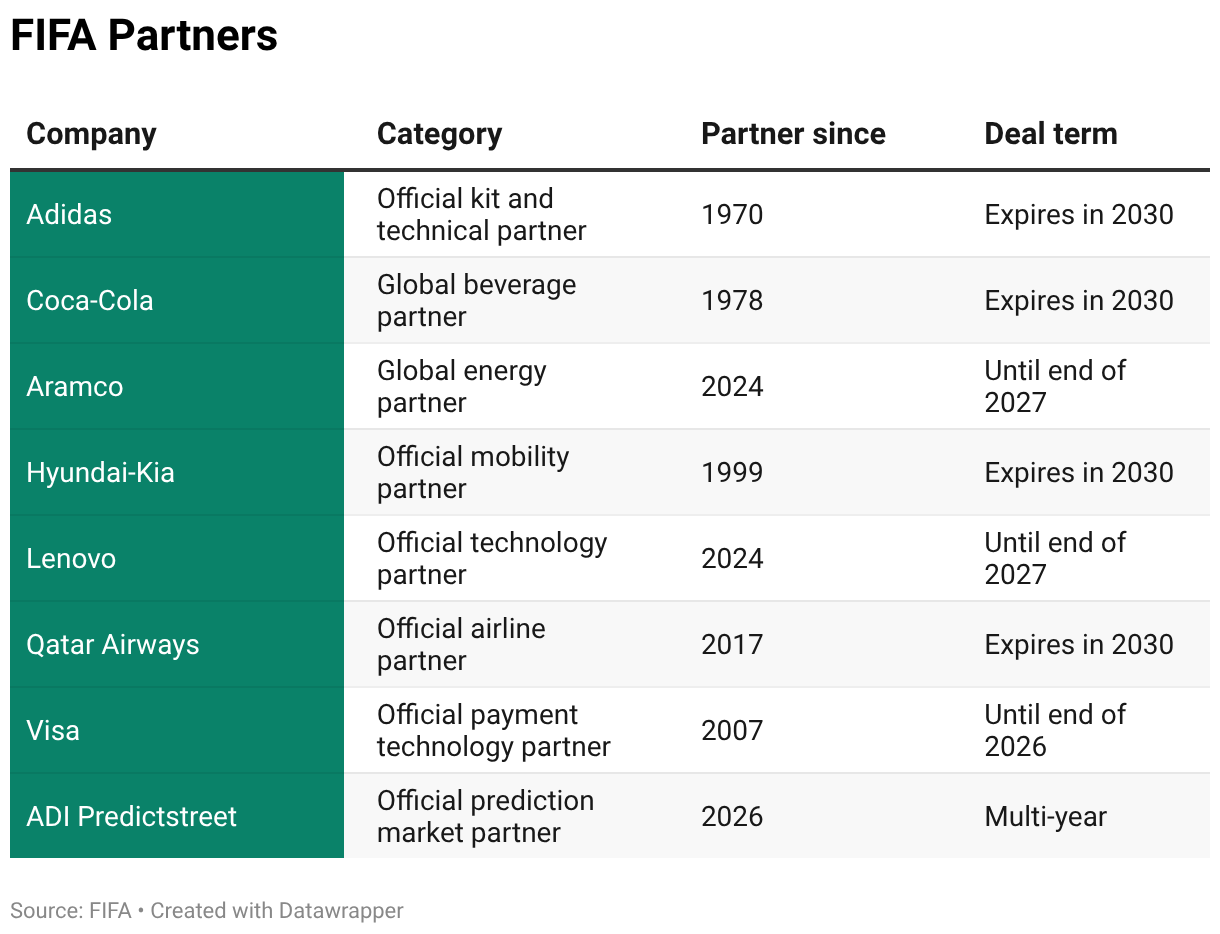
The 2026 Fifa World Cup is the first men’s tournament to be covered by a new commercial partnership structure that promises greater flexibility. Fifa’s portfolio now comprises top-tier global partners who sponsor all its events, tournament-specific sponsors, and tournament supporters with country-specific activation rights.
Fifa has nearly sold out its entire inventory and expects to generate the highest sponsorship revenue ever for a standalone sporting event. Ampere Analysis predicts revenues could be as high as US$2.4 billion – a 37 per cent increase on 2022.
Newcomers to the Global Partner tier include Saudi state oil company Aramco, Chinese tech giant Lenovo and ADI Predictstreet, which will create a prediction market platform for the tournament.
Verizon, Lay’s Bank of America and Unilever have signed up as World Cup sponsors, replacing Byju’s, Crypto.com and Vivo. Saudi Arabia’s Public Investment Fund (PIF) has signed a deal to activate specifically in North America and Asia.
Host cities are permitted to sell their own sponsorships to cover operational costs. However, cites are unable to sign up companies who compete with Fifa’s central partners and brands are limited in terms of the scope of their activations, restrictions which have dampened appeal.
Stadiums with naming rights deals must adopt generic names and cover up visible signage during the tournament to protect World Cup sponsors. The exception is Atlanta’s Mercedes-Benz Stadium, where the car manufacturer’s logo Is integrated into the design of the roof.
The bigger picture
Infantino’s close ties to US president Donald Trump have been heavily scrutinised in the lead-up to the tournament. The Fifa president has regularly appeared at the White House since Trump’s re-election and even created the Fifa Peace Prize, which was awarded to the US leader.
Indeed, Trump’s actions loom large over the World Cup. Travel bans threaten to exclude fans from several competing nations, such as Senegal and Ivory Coast, while Iran’s participation is uncertain due to US military action. The safety of spectators has been questioned due to the possible presence of US Immigration and Customs Enforcement (ICE) agents.
There is also tension at local government level, with cities frustrated at escalating costs and diminishing returns. Fifa’s refusal to subsidise local transport costs has led to transit authorities raising prices for train and bus tickets to stadiums – exacerbating the controversy over high ticket prices.
Whether the same organisational model will be used again remains to be seen. The FA and US Soccer, the expected hosts of the 2031 and 2035 Fifa Women’s World Cups, have called on Fifa to cede some control to the federations for both tournaments to avoid a repeat.
This is also the last World Cup before Fifa’s next presidential election in 2027. Infantino has confirmed he intends to stand for re-election and already has the support of three confederations, making his chances of winning highly likely – especially if this summer’s event delivers the revenue Fifa expects.
Looking further ahead, Fifa could be tempted to increase the number of participating teams from 48 to 64 should this expanded World Cup be a commercial success. Indeed, South American confederation Conmebol has proposed any changes come into effect in time for the 2030 World Cup.

Combining richer content, in-depth data and exclusive community benefits, SportsPro+ is your VIP pass into the global sports industry. Discover more here.