


Getty Images
Kim Stone is hoping that third time is the charm for the Washington Spirit.
Having joined as the first chief executive in the franchise’s history in January 2024, Stone has already seen the National Women’s Soccer League (NWSL) outfit lose two consecutive championship games. But the former Miami Heat, Golden State Warriors and Oak View Group (OVG) executive is far from downbeat.
After all, the Spirit kicked off the 2026 season in front of a sold-out Audi Field, are owned by one of the most prolific investors in women’s soccer in Michele Kang and have just tied down star player Trinity Rodman to a record-breaking contract extension.
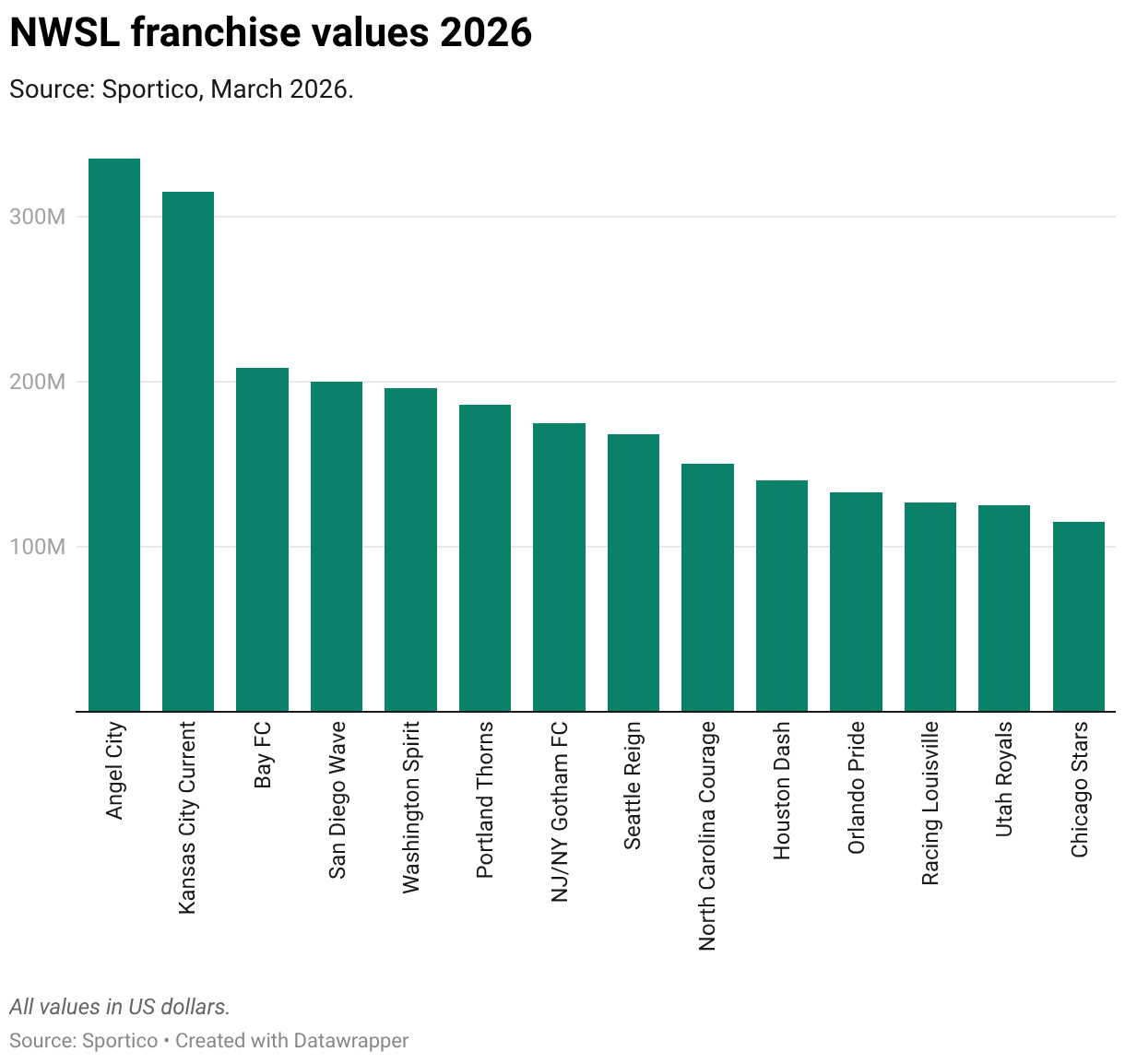
Business is booming in the NWSL’s 14th season too. Attendances and TV viewership are rising, while Sportico estimates that the 14 teams that competed in 2025 are collectively worth US$2.6 billion. Angel City lead the way with a valuation of US$335 million, with the Spirit rounding out the top five at US$196 million.
As season ticket sales and sponsorship income soared, it was the Spirit who delivered the biggest revenue growth of any club, up 66 per cent to US$19.6 million. It’s easy to see why Stone is ready to go again.
“It’s supply and demand,” says Stone, when SportsPro asks what’s driving NWSL franchise valuations. “There’s not enough supply, so demand goes up. Sports teams are scarce things.
“But in addition to that, there’s the business case for it. With the Washington Spirit, last year we had 70 per cent growth year-over-year in our season ticket base. Our metrics keep going up and up, so the business case is there. The business case has gone from ‘maybe you should invest in this’ to ‘you’re missing what’s been called the growth stock of sports’, which is women’s sports.
“We’ve had a 50 per cent increase in our corporate partnerships year over year. This year, we’re probably going to have another 50 per cent increase. Tickets are capped, I can only sell 19,200 [at Audi Field], but corporate partnerships aren’t.”
“Every smart investor is looking for a return”
When Stone first arrived at the Spirit, she says her main commercial priority was to get ticket sales “really humming”. Now, attention has turned to increasing other revenue streams, including corporate partnerships.
Stone attributes the recent jump in sponsorship income to thinking differently, getting creative and investing in front office talent. Last year saw the Spirit sign a three-year renewal of their front-of-shirt partnership with CVS Health, which the club described as one of the most lucrative deals in the NWSL. Since the start of 2025, the franchise has also extended its sleeve sponsorship with Mars and added Lafayette Federal Credit Union and Giant Food as new partners.
With marquee assets sold for this season, the club is exploring how it can carve out new inventory.
“We have to get innovative,” says Stone, who was speaking at SportsPro New York. “That takes an openness and willingness to do new things and listen to what brands and partners want. We don’t believe in an off-the-shelf package. We want to understand what brands want to do and then we figure out how to drive that.”
Stone also expects more NWSL teams to continue investing in their own stadiums and training facilities, which would create additional revenue growth opportunities and further drive valuations. She says the Spirit, who currently train and play at venues operated by Major League Soccer’s (MLS) DC United, are actively working on a dedicated practice facility, adding that she is hopeful “we’ll have something this year”.
With revenue growing across the board, Stone says Kang is ensuring that the Spirit remain “hyper focused” on reaching profitability – something the club hopes to achieve “sooner rather than later”.
“By sooner, I mean less than three years,” Stone adds. “And it’s possible. It’s why [Kang is] making these investments. Every smart investor is looking for a return.”

The Spirit currently play at Audi Field, home of DC United, but Stone says the club’s long-term ambition is to have more control over its home stadium (Image credit: Getty Images)
NWSL needs players with the “whole package”
Arguably the Spirit’s most noteworthy piece of business during the offseason was Rodman’s contract extension. The new three-year deal, reportedly worth more than US$2 million, makes the 23-year-old the highest-paid player in NWSL history and, according to her agent, the highest-paid female player in the world.
The deal ended speculation over Rodman’s future after she had reportedly received lucrative offers from abroad, including clubs in England’s Women’s Super League (WSL). Widely regarded as one of the world’s top talents, the American is also one of the NWSL’s biggest draws. Indeed, the American ranked 120th in SportsPro’s 2025 list of the world’s most marketable athletes, illustrating the role she plays in bringing attention to the league.
Stone is well aware of Rodman’s crossover appeal among different audiences and says she even put together a “one-pager” for Kang to quantify her impact on the business.
“She’s got this whole package, and I always joke now that I have to go out and pay for her,” Stone says. “But listen, it’s not me, it’s her and her ability and her brand. We’re thrilled to have her, partner with her, and I know already we’ve seen a lot of business results from that.
“We will continue to track it, because we invested a lot in her, she’s worth it, and now we just have to make sure that we execute on that.”
Rodman’s new deal came after the league introduced the ‘High Impact Player Rule’, allowing each club to exceed the competition’s salary cap by up to US$1 million to retain players who meet various commercial and sporting criteria. However, the rule has been challenged by the NWSL Players Association (NWSLPA) on the grounds that its “unilateral implementation” breaches the terms of the current collective bargaining agreement (CBA).
Whatever the outcome, Stone says it won’t change the Spirit’s contract and believes the NWSL needs stars who, like Rodman, have the “whole package” and have the ability to “drive your business forward”.
“Trinity gets us into fashion, she gets us into other areas,” she continues. “There’s been a question of, ‘why don’t you just take this million dollars and put it into the salary cap?’ The difference is if you put it into the salary cap, you’re leaving it in the hands of folks that are more focused on the results on the pitch and not necessarily how that person also drives the business side.
“By having the High Impact Player Rule, it allows the sporting operations to understand the key things that drive the business forward, to understand that we value these players because they have that ability and not just sign another player because we’re going to win more.
“Winning absolutely matters. But it also matters that you have stars.”
Expansion can’t risk “diluting the talent”
Stone was speaking to SportsPro shortly after NWSL commissioner Jessica Berman confirmed the league expects to award its 18th franchise later this year. Alongside Atlanta, who are paying a US$165 million expansion fee, the team would be one of two clubs joining the competition in 2028, by which point the league would have doubled in size since 2019.
Expanding into new markets will increase commercial and media rights inventory but also require revenues to be shared across a larger group of clubs. Stone, though, believes the pace of expansion is being handled carefully.
“What we have to balance, and I think the NWSL has done a good job with this, is not diluting the talent,” she says.
“I trust in the league and how we’re growing. The commissioner has said she wants to get to 30 [teams]. Then you can do conferences, which also cuts down on your costs because now you’re just flying on the East Coast. You’re not making these cross-country trips, which cost more money.”
Stone will hope the Spirit can add several more NWSL titles before the league eventually expands to 30 franchises. And while winning is the immediate goal, the long-term ambition stretches far beyond trophies.
“Five years, a practice facility,” says Stone. Ten years out, we need to have more control in a stadium. So whether that’s our own stadium or in a partnership with somebody and not [being] a tenant.
“In addition to that is the fact that you’ve got the men’s World Cup this summer in the States, the Women’s World Cup in Brazil next year, the LA28 Olympics and then in 2031 you have the Women’s World Cup in the United States. You’ve got that cadence for soccer, the interest is going to massively rise.
“We have an amazing opportunity before us, so I’m super excited about what that means because our strategy is based on making sure we’re leveraging all those points.”

Women’s sport audiences are surging, but billions remain untapped. SportsPro London’s dedicated content track shows investors, sponsors, rights holders and media how to close the monetisation gap and scale this high-revenue opportunity. Taking place this April, learn more here.