

Getty Images
The start of the National Basketball Association (NBA) and National Hockey League (NHL) playoffs in mid-April is one of the busiest periods in North American sport, with wall-to-wall knockout matchups filling television schedules and streaming platforms for several weeks.
These games are the most meaningful component of both leagues’ broadcast deals, with high-stakes competition capable of attracting large national audiences for sports where interest remain predominantly local – at least for now.
This festival of sport culminates with the NBA Finals and the Stanley Cup Finals, both of which will air in June on ABC, which hopes free-to-air (FTA) coverage and exciting series can generate up to 14 nights of huge ratings.
But regular season viewership is just as important for properties eager to prove to potential partners that they can deliver consistent figures across the whole campaign, helping them to shift subscriptions and attract advertisers.
The NBA and NHL are at different stages of their domestic broadcast arrangements, but both have reported higher national viewership for the 2025/26 season. But how have the figures been affected by changes to methodology, what do they mean for their relationships with broadcasters, and how will they impact both their future strategies amid chaos in the regional sports network (RSN) space?

Amazon Prime has joined the NBA broadcast roster for the first time (Image credit: Getty Images)
NBA delivers the goods for new media partners in year one
The NBA is in the first season of new 11-year broadcast deals with Amazon Prime Video, ESPN and NBC worth US$76 billion that represent a three-fold increase in media revenues from the previous cycle.
This growth can be explained by the NBA’s rising popularity and a roster of star players which means many of its games have significant national appeal, attracting broadcasters desperate for content capable of driving regular large live audiences.
The combination of over-the-air (OTA) transmission on ABC and NBC, key games on streaming services, and a significant presence on ESPN, which remains the country’s most influential sporting platform, also ensures wide availability among both casual viewers and seasoned sports fans.
More than 170 million people watched NBA games during the 2025/26 season, with average viewership up 16 per cent to 1.78 million – the most in seven years. Basketball fans watched NBA matches for a combined 920 million hours, a 25 per cent increase on last season and the most for 14 years. On top of that, social views rose by 13 per cent to 228 billion and viewership for both the NBA Cup and NBA All-Star Game viewership was up.
Crucially, more than 57 games averaged two million viewers, the most since 2011/12, and is evidence of the league’s ability to deliver consistent ratings for its new partners who are eyeing a return on investment.

Connor McDavid is one of the biggest stars in the NHL (Image credit: Getty Images)
NHL sees gains ahead of 2028 renewal
The NHL is in a different situation. It is in the fifth year of seven-year pacts with ESPN and Warrner Bros Discovery’s TNT Sports worth a combined US$4.4 billion and will soon take its post-2028 rights to market.
According to Sports Media Watch, the league will be buoyed by a 23 per cent increase in average viewership to 540,000 – the best since 2012/13 when NBC held the rights. Games on ESPN and ABC increased by 30 per cent to 760,000 and matches on ESPN alone rose by 48 per cent to 602,000. WBD averaged 381,000 across TNT and Tru TV.
The Stadium Series clash between the Tampa Bay Lightning and Boston Bruins achieved a regular season cable record of 2.07 million viewers, while all the league’s partners benefited from a post Winter Olympics viewership boost following USA’s victory in the men’s ice hockey tournament.
Both leagues will be encouraged by the figures but it is important to mention that they are based on Nielsen’s ‘Big Data + Panel’ methodology that includes data from streaming services alongside traditional audience capture methods. Many major properties in the US have reported increases in viewership since the new methodology was rolled out.
Post-season prospects
Both leagues will hope that any regular season viewership bounce will continue into the post-season and their respective championship series. But, as recent years have proved, the extent of viewership is as much about exciting series and team composition as it is about long-term trends.
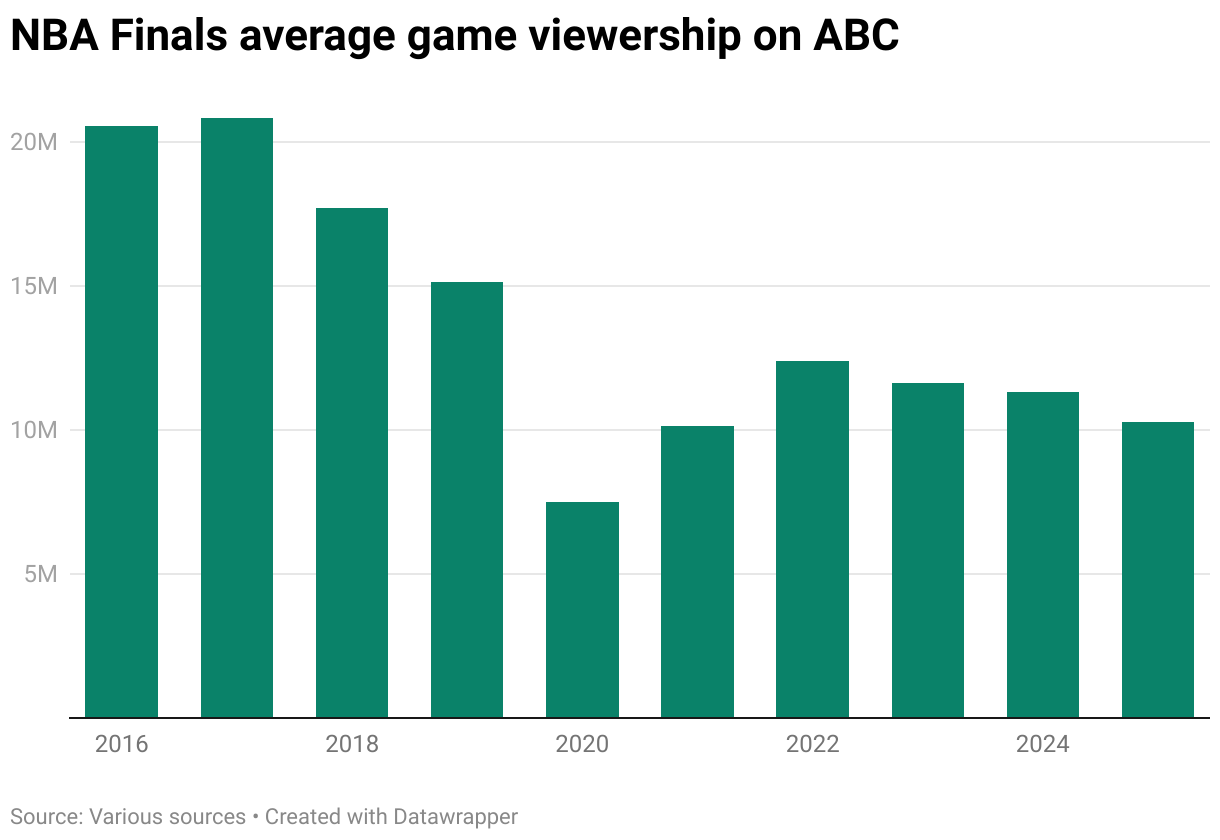
Excluding the finals, the NBA playoffs averaged 4.03 million last season, with ESPN and ABC averaging 10.27 million for the seven-game NBA Finals between the Oklahoma City Thunder and Indiana Pacers. Game seven averaged 16.35 million, peaking at 19.28 million, the best performance since game six of the 2019 Finals between the Golden State Warriors and Toronto Raptors averaged 18.34 million.
However, the 2025 NBA Finals were the least watched championship round since the Covid-affected 2021 series between the Milwaukee Bucks and Phoenix Suns, which averaged 9.91 million viewers. The decrease has been attributed to Oklahoma City and Indianapolis being smaller media markets in the US.
While long-term national interest in the NBA should begin to offset such fluctuations, the league would expect the presence of one or two big-market teams, changes to Nielsen’s methodology, and the impact of its new broadcast deals to deliver a big number in 2026.
As for the NHL, it will almost certainly beat the 2.5 million average for last year’s Stanley Cup Finals, a decline of 40 per cent on the previous year. All matches were behind a paywall on TNT Sports and the series involved two teams with relatively limited national appeal in the Florida Panthers and Edmonton Oilers.
ESPN, which alternates the Stanley Cup with TNT, will air the 2026 Finals over-the-air on ABC, ensuring much wider availability. An exciting series, the presence of at least one major team (Boston from the East or LA from the West would be top of the NHL’s list) and a post-Olympic honeymoon could help deliver increases that go beyond the impact of Nielsen’s changes.

13 NBA teams are affected by Main Street Sports’ exit from the RSN space (Image credit: Getty Images)
What these ratings mean for local broadcast deals
National relevancy is important given the structural changes happening in local media. Both NBA and NHL teams can sell their in-market rights to games not selected for national broadcast. Most recently, this has been a team-owned or third-party RSN which used local sports to extract lucrative carriage fees from cable networks.
However, a decline in pay-TV households has undermined the economics of this model, while the largest operator of RSNs, Main Street Sports Group, is set to admit defeat in its battle to be financially sustainable once the current NBA and NHL seasons end. Main Street’s financial uncertainty has affected 13 teams from the former and seven from the latter.
The NBA and NHL are less exposed to the situation than MLB but local media remains an important source of revenue and exposure. Several teams who have left or been discarded by Main Street in the past few seasons have opted for a mixture of OTA and direct-to-consumer (DTC) distribution, while others have sought alternative RSN arrangements.
But, longer term, both leagues could centralise local rights to extract more revenue from their national broadcast arrangements. In-market and out-of-market rights could be bundled into a single proposition that can be sold to a streaming platform. MLB already does this with ESPN, which also distributes the out-of-market NHL.TV, and the NBA has confirmed plans to create a local streaming hub.
While potential suitors would undoubtedly look at the local data before making a decision, the national numbers have significant context.
