

Getty Images
Influencers have begun to play an increasingly important role in sport, whether through on-the-ground promotion during live events or through the ancillary content they create on platforms such as YouTube and Twitch.
Ampere’s Sports Consumer data shows that in nearly all markets surveyed in Latin America (LatAm), North America and Europe, over half of sports fans say that they watch influencers or personalities doing ‘watchalongs’ or discussing sports events on social media platforms. These watchalongs are often done by streamers without the live rights, so fans are being drawn more to additive commentary and perspectives of the influencers.

In recent years, rights holders have begun to capitalise on this growing trend by entering into rights deals with streamers so that fans can watch live sport both on platforms more native to them and also get the benefit of the influencers’ content on top. These deals allow rights holders to tap into audiences who may not watch sport through traditional linear or streaming platforms and also those who skew younger.
As attention continues to split across platforms and content types, changes in media rights distribution strategies, and a willingness to take risks, are going to be key in attracting new audiences to competitions and safeguarding the future of that sport.
The pioneer of influencer-led sports streaming is CazéTV, a Brazilian YouTube channel fronted by streamer Casimiro Miguel. CazéTV’s success in live streaming sport has helped the channel build up a portfolio which includes the men’s Fifa World Cup, Winter Olympics, Uefa Europa League and LaLiga, among others, spending more than US$160 million on sports rights in 2026.
In 2025, meanwhile, rights holders outside of LatAm also started to experiment with this model. In the UK, British rugby influencer Tim Cocker secured rights to France’s second-tier Pro D2 for his FR-UK channel, where he hosts with Brive’s defensive coach and former England international Joe Worsley. Over in France, influencer Zack Nani signed an exclusive deal for 14 French under-21 matches and paid a low six-figure sum for up to three Saudi Pro League (SPL) matches per week.
The deals that caught everyone’s attention, however, came from the Bundesliga. The league negotiated deals with Sky, Amazon and the BBC in the UK, making UK£8 million to UK£10 million in traditional broadcast revenue based on Ampere estimates. In addition, the league announced deals with two popular podcasts – Mark Goldbridge’s That’s Football and Gary Neville’s The Overlap for non-exclusive Friday night games. These Friday night games are also available on BBC iPlayer and the Bundesliga’s YouTube channel.

All the creator-led deals in Europe have two things in common. Firstly, they were not a big risk for the rights holder, and secondly, they reflect an adaptation to changing consumption habits as more sports fans turn to influencers to enhance their sports viewing.
The Bundesliga had the broadcaster money to fall back on, Pro D2 Rugby would be unlikely to get a broadcast deal or rights fee in the UK, and the Saudi Pro League had not performed particularly well on Canal+ in the previous season in France, meaning Zack Nani offered reach it was not currently achieving.
More from Minal Modha


What approaches did the content creators take? And what were the results?
When we look at the deals in Europe, we can see a variety of different approaches in execution. In the UK, Mark Goldbridge’s channel employed a mixture of watchalongs and live streams straight from the Bundesliga’s world feed with no additional content. The Overlap did the latter throughout the season, with no further additions to the streams, while FR-UK took the Canal+ feed for the rugby, with Cocker and Worsley providing commentary on top.
Nani’s coverage in France, particularly of the SPL, leant more towards creating an experience beyond the live game. Not only did Nani commentate on all the games, he also brought in other influencers to help increase reach and ex-commentators and journalists to offer more insight – similar to Worsley’s presence on FR-UK.
In addition, Nani’s choice of titles for the videos is strikingly different to the other creators. His are particularly descriptive and try to build up hype and narrative around the game and its role in the season, whereas The Overlap and That’s Football tended to have simply ‘Live Bundesliga’ in the title.
The differences in approach, unsurprisingly, had an impact on the audiences each channel was able to attract. Analysis of the videos found that simply showing a world feed with no additional enhancements attracted the lowest average audiences. Across the season, The Overlap drew an average of 14,243 viewers across 19 videos, while That’s Football’s live streams generated 35,713 across 24 videos.
Conversely, for the videos where Goldbridge did watchalongs for Bundesliga games, the average audience increased by 22 per cent to 42,727 viewers across 18 videos. The impact of additional content above and beyond the live is most starkly evident in the engagement Nani got for his live SPL coverage in the last season. Ampere found that 58 of Nani’s videos garnered an impressive 3.2 million cumulative views and an average of 54,446.
While Nani’s numbers are impressive, there will always be games which do better than others. The top four videos, all of which featured Cristiano Ronaldo’s Al-Nassr, did account for 22 per cent of all views, highlighting the impact of the Portuguese star, but Nani was also able to capitalise on a run-in which saw the title race go down to the wire. At the other end, some of the games he showed attracted as little as 10,000 viewers. So even with additional content, consistently high engagement is not guaranteed.
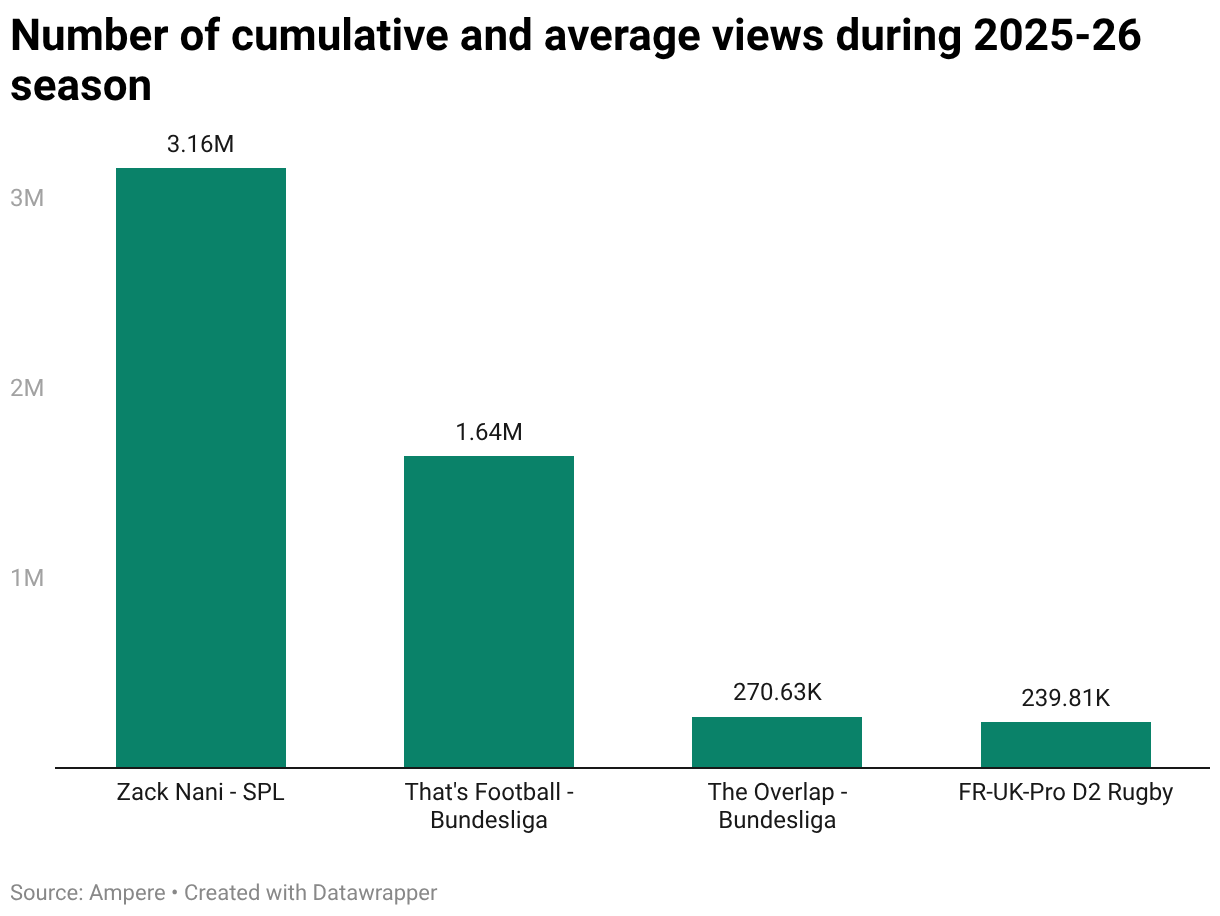
What these numbers highlight is an alternative distribution strategy for tier two or tier three properties. As competition for viewer attention continues to rise, and audiences deem YouTube to be comparable to just TV, a lack of representation on the platform could be considered a risk. If the rights being handed to influencers are in international markets where revenues are likely to otherwise be low or non-existent, then deals with content creators can only really have an upside. It offers the ability to engage a new audience, but through a platform or service they already watch and enjoy.
Not every influencer who signs a deal with a rights holder will reach the heights of CazéTV or Nani, but that is also true of traditional broadcast partnerships, and there is currently little to no money changing hands for these deals in Europe.
So while there is some risk for rights holders, the upside of new audiences in an increasingly competitive attention economy could be worth the gamble.
Ampere Analysis is the exclusive provider of consumer and media rights data and insights to SportsPro’s commercial guides, which provide the latest business intelligence for the top leagues and events. Access the guides by becoming a SportsPro+ member today.