


Getty Images
Germany’s top-flight soccer league prides itself on its passionate fan culture and electric matchday atmosphere. Now, the Bundesliga wants to make more noise globally as it brings ‘football as it’s meant to be’ to fans around the world who may never set foot in one of its stadiums.
Bundesliga International operates a multi-dimensional marketing approach to reach fans around the world, whether it’s through broadcast deals, bespoke content creation or even collaborating with other leagues like the National Football League (NFL). From academy programmes to content partnerships and the Bundesliga creator network, this ensures fans around the world have regular touchpoints to the league.
A bigger global fanbase ultimately means more revenue. Although domestic media rights income increased in the most recent cycle, the league still has untapped potential outside Germany.
“While we continue to grow our global fanbase,– the league and our clubs – need to be even more vocal and active in the sense of marketing, PR, and being close to the broadcasters,” Robin Austermann, executive vice president at Bundesliga Americas, tells SportsPro. “That’s why we are set up as part of the overall DFL picture, with marketing, PR, content, and also teams on the ground across seven key territories.”

The Bundesliga hasn’t been afraid to experiment with its international media rights to maximise reach and revenue (Image credit: Getty Images)
A market-by-market approach
The Bundesliga prides itself on undertaking extensive research into each country when picking its partners, identifying key trends and analysing market data before applying learned insights to its approach.
In Brazil for example, it noted that pay-TV penetration was just eight per cent, meaning a cable broadcaster would not reach the majority of the population. Therefore, among others, the league struck deals with popular YouTube channels Cazé TV and Canal Goat, taking the plunge before other leagues adopted a similar approach.
All in all, the competition has seven broadcast partners in that market. This might seem a lot, but the strategy is working well so far, with the Bundesliga generating up to five million live views each matchday, becoming the most-watched European league in Brazil in the process. Originally set up to maximise reach, the league claims the move is also delivering increasingly impressive revenues.
However, this tactic might not be as effective in Europe, where pay-TV channels are considerably more popular and where the rights landscape is fundamentally different.
“We need to look into fan development to build even more fans in a certain territory,” says Austermann. “Afterwards, this can translate it into broadcast revenues. Even then, the media rights awarding can be seen as part of the overall marketing mix as we identify and introduce new approaches.”
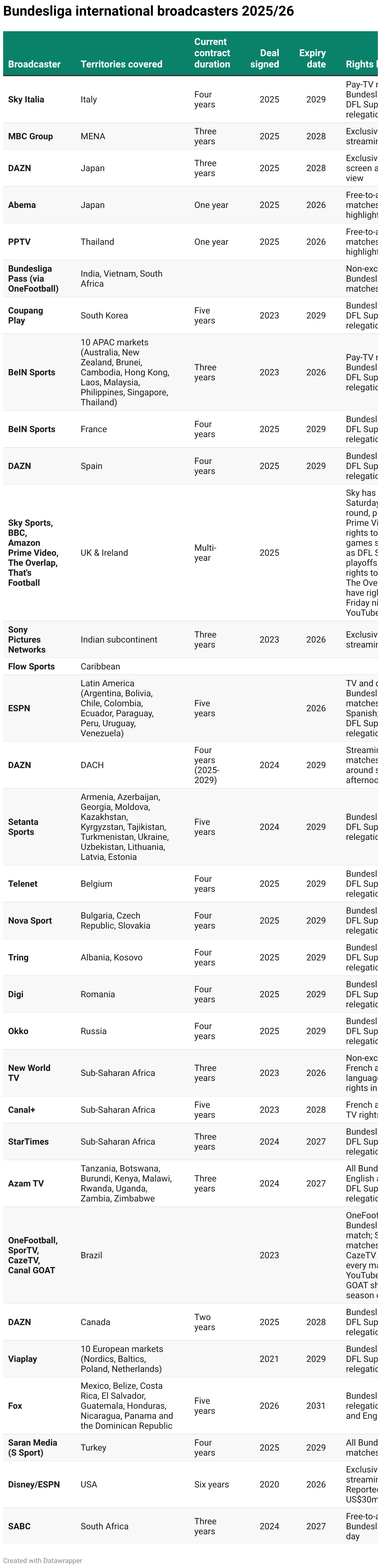
Finding a “really compelling” mix of UK partners
There is perhaps no better example of that strategy coming to life than the Bundesliga’s new broadcast partnerships in the UK.
Last August, the league renewed its deal with Sky Sports and awarded Amazon Prime Video the exclusive rights to show all Sunday afternoon matches on a pay-per-view basis. But the most eye-catching move was the decision to award up to 20 Friday night matches not just to the BBC – but to ‘The Overlap’ and Mark Goldbridge’s ‘That’s Football’ YouTube channel. Those deals are complemented by the Bundesliga’s own YouTube offering and app, as well as the its first-ever FAST channel in the UK and Ireland, which launched in December in partnership with Samsung TV Plus.
Given the gap in international media rights revenue between the Premier League and other competitions, Bundesliga International chief executive Peer Naubert and his colleagues felt they had to take an innovative approach – particularly in the UK, where the English top flight reigns supreme. The expansion of Sky’s Premier League deal meant it had even less space for the Bundesliga, forcing it to find additional partners.
“We needed to think a little bit more progressive and find additional opportunities,” Naubert says, speaking on-stage at November’s SportsPro Media Summit in Madrid. “One part of our marketing mix is our media strategy, because that brings us into a position to figure out whether we go for a reach approach, or follow a revenue approach, or try to combine both.
“When we did our homework for the UK, we came to the conclusion that a mix of different partners would be really compelling because that would help us to truly drive eyeballs while still maintaining significant and good value for us.”
The experimental approach appears to have been worth taking. According to Naubert, viewership for the Friday night window has multiplied by 15 to 20 times and there has been a significant increase in younger viewers.
“We have pretty much maintained the same financial values,” Naubert adds. “The challenge for us, is that in the past we had one partner and now we have multiple partners. We have to service and speak to them on a regular basis, and that creates a lot more effort comparatively on our end. We have set the industry standard – this is feedback we regularly receive – and it is important for us to maintain that.
“But I think it’s for the better of the Bundesliga in the UK. If you look at the feedback from our media partners so far, it’s very positive because they’re demanding more and more content on a weekly basis.”
‘It’s our duty to make every match available’
Direct-to-consumer (DTC) is also part of the Bundesliga’s strategy. Bundesliga Pass serves as both a solution for dark markets and a complementary service in territories where a local broadcast deal is in place. It is now available in India, South Africa and Vietnam through OneFootball’s platform, which offers every Bundesliga and Bundesliga 2 match via pay-per-view or a season pass.
“We see it as our duty to make all of the Bundesliga matches available to everyone in the territory,” Austermann says of Bundesliga Pass. “It is just one additional option that we have in the market.
“If a broadcaster, for whatever reason, is not in a position to broadcast all of the matches due to scheduling conflicts or for other reasons, we are still in a position to broadcast all of the other [games] and to make them available to the fans.”
As for whether the Bundesliga plans to roll out the service elsewhere in the future, Austermann says it is too early to consider expansion, with any decision dependent on the country in question.
“It’s really too early to tell, because we are looking at all the options in every market, and then we see the possibility,” he states. “It’s a complement to what we are doing, and we are sure that DTC will have a relevant role in the future. When there’s a fit in terms of non-exclusive packages, or when we see the need to do it, and when we can also benefit from it, then we will do so.”


Focus on the Americas
While overseas deals have been struck in key markets over the past 12 months, the US is a priority for the Bundesliga, whose broadcast partnership with ESPN expires at the end of the 2025/26 season. Negotiations have been ongoing for several months and although the Bundesliga is happy with ESPN, it is making its offering attractive to as many broadcasters as possible by enhancing its on-site production capabilities and offering weekly newsletters to engage fans.
The initiatives are part of the Bundesliga’s 17-year collaboration with US agency Relevent, which manages the league’s media rights and also works on regional partnerships, developing local content, marketing and PR strategies, and servicing clubs. Together with Relevent, the Bundesliga Americas team also runs dedicated Latin American content studios in Guadalajara in Mexico.
“Our belief is that the strategy doesn’t work if you enter a two or three-year deal [with an agency], because the overall onboarding process, building a team, telling a long-lasting narrative in the market, works if it’s a longer-term deal. Therefore, collaborating with Relevent for 17 years – the longest deal that we have ever made – underlines that holistic approach.”
Looking ahead, it’s no surprise to find that the Bundesliga plans to retain the core principles of its international strategy, ensuring that it is reaching fans on the right platforms in the right markets. To that end, Austermann says the league has to keep across changing media trends while being able to monetise growing interest in the competition.
“We need to keep our eyes open all the time, because there are so many changes in the media market,” he adds. “Two or three years ago, we wouldn’t have thought about selecting Mark Goldbridge as a content creator in the UK and awarding media rights to him. This has now changed.
“We have a clear vision, which is maximising revenues by building brand equity. So being local, launching dedicated projects in a market with our own resources is definitely key.
“We are the most fan-centric league in the world, and we need to find the best possible way to translate that interest into international markets.”

Get your daily briefing of all the essential news across the sports industry with the SportsPro Daily Newsletter. Subscribe here.