


Image credit: Getty Images
The introduction of the Champions League’s new ‘Swiss-style’ model marked what Uefa described as the ‘most radical transformation’ of European soccer’s premier club tournament in a generation. Yet the governing body’s competitions are also undergoing a sweeping commercial overhaul.
Uefa promised its expanded 36-team club competitions would produce more jeopardy and more regular fixtures between Europe’s biggest teams – but the increase in games has also armed it with more commercial inventory to take to market. After delivering €4.4 billion in club competition revenue during the first year of the new format and introducing the model to the Women’s Champions League from this season, those tasked with commercialising the rights are eyeing further growth during the 2027 to 2033 cycle.
That commercial strategy is now delivered by UC3, the joint venture between Uefa and European Football Clubs (EFC), and its new agency partner Relevent Football Partners (RFP), who together manage and sell some of the most premium commercial inventory in soccer. Rights to tournaments like the Champions League were previously overseen by Uefa itself, but the new UC3 structure is designed to give the teams who participate in the governing body’s competitions a greater say in how they are commercialised.
According to Charlie Marshall, who is chief executive of EFC and a co-managing director of UC3, the new approach not only provides stability, but also enables “more risks to be taken” and decisions that “don’t simply default to the status quo”.
“Through quite a turbulent time in football, this is one project and one ambition that both Uefa and the clubs always held very firm,” says Marshall. “We have a fundamental belief that this structure is necessary to enable some really important things commercially.”

Why did Uefa end its partnership with Team?
One of UC3’s first major decisions offered a clear indication of that desire to shake things up.
Team Marketing was established alongside the modern Champions League in 1991 and had been selling the commercial rights to Uefa’s club competitions ever since. However, the Lucerne-based agency’s exclusive grip on the tournament started to loosen in 2022 after Uefa ran a request for proposals for the first time, forcing Team to bid alongside other interested parties to retain the business.
While Team kept hold of the lion’s share of the rights for the current 2024 to 2027 cycle, Relevent Sports landed the broadcast sales remit in the US, guaranteeing Uefa US$250 million per season to secure the contract.
After impressing in that role, UC3 handed the US-based company – which is controlled by Miami Dolphins owner Stephen Ross – a global sales brief for the next six-year cycle, ending one of the longest-standing agency partnerships in sport. It also led to the formation of RFP, which is headquartered in London and has offices in New York, Nyon, Doha and Southeast Asia.
Reflecting on the decision, Marshall stresses that Team had done “an incredible job” for 30 years and points out that there was “nothing they were doing wrong”. But the creation of UC3, alongside the overhaul of Uefa’s club competitions, meant “it was the right time” for a change.
“The need for a new narrative, the need for a new story in the market, was actually really paramount,” he continues, speaking alongside Uefa marketing director and fellow UC3 co-managing director Guy-Laurent Epstein. “It’s almost the plight of the incumbent. It’s quite difficult for an incumbent to tell a new story. With the best will in the world, it’s just very difficult for that to happen, whether that’s us or whether it’s an agency that’s been around for a long time.
“We needed an injection of fresh blood. We needed an injection of fresh perspective, fresh insight, not a copy and paste in any way – an organisation with experience of different markets, different perspectives, different sports, who could come and help us tell the story in a new way. That was what led us to Relevent Football Partners.”


How are the media rights being sold?
Media rights for the Champions League have typically been awarded in three-year cycles, but broadcasters are being offered the opportunity to show the tournament for four seasons, providing a longer runway to commercialise their coverage without needing to reenter a tender process after one year.
The new media rights strategy has been headlined by the introduction of a global first-pick package of games, including a new standalone fixture to kick off the Champions League season hosted by the previous year’s winner. That move was strategically designed to bring the likes of Netflix, Apple and Disney to the table, creating the competitive tension required to drive up the value of the rights.
In addition, tenders have been launched in several key territories simultaneously in another attempt to engage global streamers, while also appealing to regional players who might equally be interested in scaling their coverage across multiple core markets.
“The strategy was to make sure that we were able to have conversations with all the actors based on their business model and their positioning on the market,” Epstein explains. “Offering the ability to be global, regional or local gave us the ability to talk to the overall spectrum of the potential candidates for those rights.”
Paramount+ is set to broadcast the Champions League in the UK and Germany after impressing with its coverage in the US
Who has won what so far?
Europe’s top five markets were first up and reportedly delivered an average annual increase of 20 per cent, largely thanks to Paramount+, which secured the Tuesday first-pick package in Germany and Wednesday first-pick matches in the UK. While one of the tech giants didn’t take up the global rights option on this occasion, Epstein says there was interest from those companies and discussions “on that basis”.
The move marks Paramount’s first major sports rights acquisition in Europe and the company will no doubt be hoping that the Champions League helps drive subscriber growth for its streaming platform in two of the continent’s biggest media markets.
While Paramount+ hasn’t been a prominent player in European sports broadcasting, it does already show Uefa’s club competitions in the US through a deal also brokered by Relevent. Indeed, Paramount-owned CBS has earned plaudits for its Champions League Today studio show, which Epstein describes as “the benchmark” for coverage of the tournament.
It hasn’t been confirmed whether the same cast of Kate Abdo, Thierry Henry, Jamie Carragher and Micah Richards will be appearing on European screens, but Marshall suggests the broadcaster’s approach and “irreverence” played a part in entrusting it with the rights in such key territories.
“It may have been a surprise to observers in this market, but not a huge surprise to us, because we’ve been developing a relationship with them In the US over the previous few seasons,” he adds. “The way that they value the product, the competitions, is impressive, especially in the US, which is a very crowded market.
“It remains to be seen what the right approach will be in Europe. It’s a different market than in the US, but I think we all have really engaged with their approach.”
Amazon’s Prime Video also secured packages across Germany, Italy and the UK, where Sky Sports has reentered the picture by picking up rights to the Europa League and Conference League.
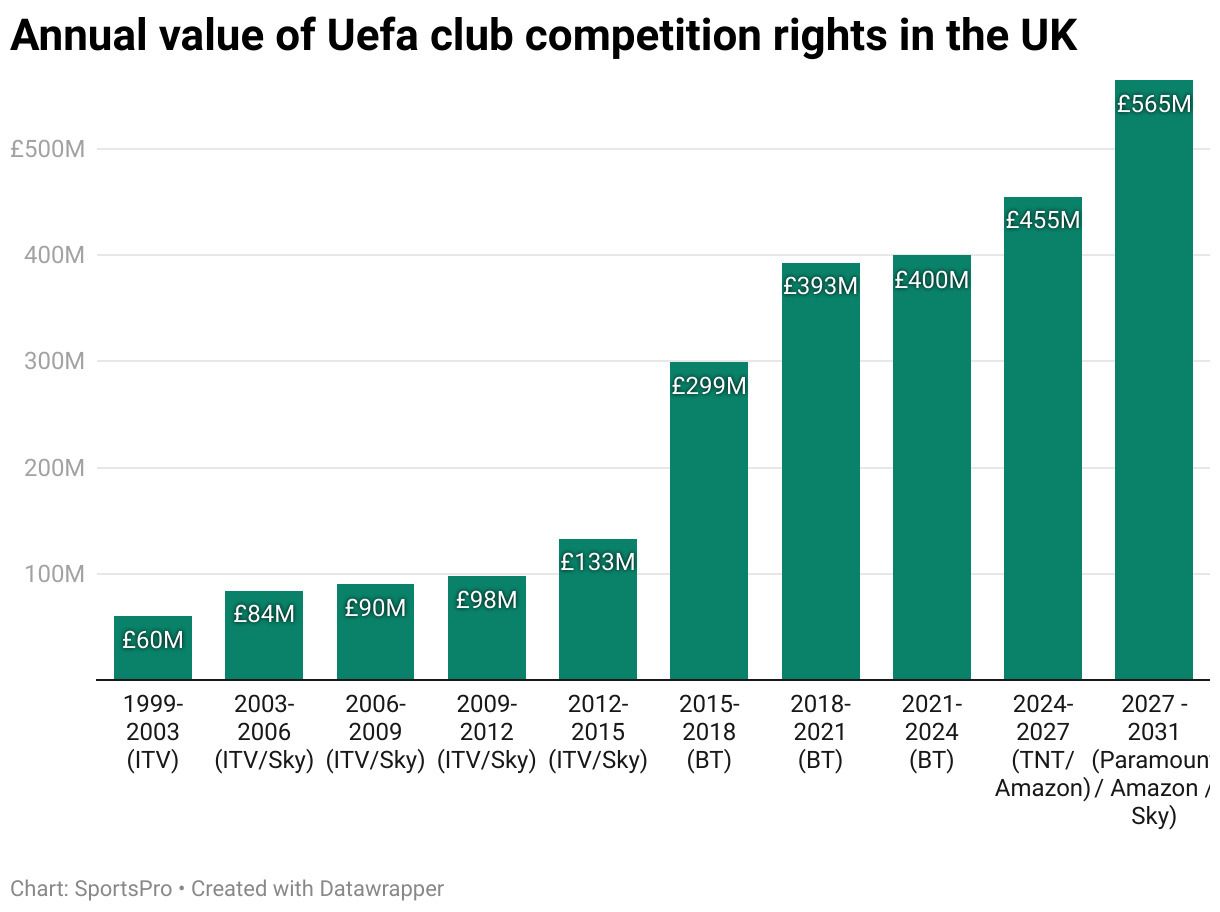
SportsPro understands that the deals in the UK are worth a whopping UK£2.2 billion in total. That breaks down to UK£565 million per season, a significant uplift on the annual UK£455 million Uefa is receiving from TNT Sports and Amazon for the current cycle. It will also be viewed by both UC3 and RFP as evidence that the new approach is working.
What will the Champions League’s sponsorship portfolio look like?
The search for competitive tension has also extended to sponsorship. UC3 and RFP have already kickstarted the sales process for the next cycle, which will allow brands to sign six-year contracts, up from the current three.
Combined with the popularity and reach of Uefa’s club competitions, the exclusivity provided by the governing body’s ‘clean stadium’ policy means that sponsors pay a premium to be associated with the Champions League. The current cycle is expected to deliver €2.2 billion in commercial revenue, up from €1.6 billion between 2021 and 2024.
However, organisers believe a new tiered structure and an enhanced set of benefits facilitated by the closer collaboration between Uefa and the clubs will deliver even more value for sponsors.
The Champions League currently boasts nine partners and five official licensees, but that will change for the 2027 to 2033 cycle, when there will be 12 sponsors of the competition. That includes four premium partners, whose deals will also span the Europa League and Conference League, along with eight other sponsors in the new tiered system – each with a tailored set of rights. There will also be dedicated Europa League and Conference League partners, just as there are now.

While some of the current Champions League sponsors have longstanding relationships with Uefa, UC3’s appetite for change appears to have reignited competition in categories that have been occupied for decades – increasing the value of those deals in the process.
The first evidence of that came at the end of last year, when AB InBev entered exclusive talks to take over from Heineken as the official beer sponsor of Uefa’s men’s club competitions after tabling an offer worth a reported €200 million (US$232 million) per year.
“The creation of UC3, the launch of the new format, the rapidly changing market conditions, the introduction of a new agency, the telling of a different story, that’s creating conditions that maybe weren’t there before,” says Marshall, reflecting on the switch to AB InBev.
“And the ability for a long-term deal, new entrants, they’re going to invest more if you give them a longer horizon. Those conditions were almost perfect for a partner like that to come in.”
Given that Heineken, whose current deal is reportedly worth €120 million (US$139 million) annually, has sponsored Uefa’s club competitions since 1994, it appears that no partner’s place is guaranteed for the next cycle. At the same time, Marshall is keen to point out that PepsiCo is set to renew as soft drinks partner of the competitions, illustrating how some of the incumbents are moving to protect their territory.
“As much as we’re open for new business – and we really are, we’re happy to disrupt, we’re happy to shake things up – we also have a lot of respect for long-term partners,” Marshall adds. “We know what they can deliver. We know what they can bring. And if they want to be with us, if they want to be in the right space going forwards for us, then that can happen as well.”

Heineken’s long-running sponsorship of Uefa’s club competitions is coming to an end as the Champions League transitions to a new tiered structure (Image credit: Getty Images)
What’s coming next?
With AB InBev and PepsiCo confirmed, there are still ten Champions League sponsorship slots to fill for the 2027 to 2033 cycle.
Meanwhile, UC3 and RFP recently launched media rights sales in more than 20 territories, including markets in Europe and the Americas, representing what SportsPro understands is one of the most expansive tenders in the history of Uefa’s men’s club competitions.
That process has already seen Ziggo retain the rights to the competitions for another four seasons in the Netherlands. SportsPro understands that pan-regional platforms and global streamers also tabled offers, but Ziggo’s determination to keep the rights delivered another significant uplift in revenue.
With the rights still up for grabs in other territories, including countries like Portugal, Brazil and Mexico, Epstein says UC3 is expecting growth “in many other markets”.
That is ultimately the aim for Uefa, which is reportedly seeking more than €5 billion in annual media rights revenue for the 2027 to 2033 cycle. Even though Epstein says “the sky is the limit” financially, neither he nor Marshall will be drawn on hard targets.
“We don’t want to repeat the practices of the past and lock everything too early in the cycle towards definitive outcomes,” Marshall adds. “We want to maintain as much flexibility now. The longer the cycle goes, the closer it gets to actually being executed, we’ll have to narrow things down. But we have the luxury of still being a good year and a half out, with quite a bit to run and quite a bit to try and experiment [with].
“We see growth – we definitely see growth – but we’re not going to pin ourselves down to being too predictive about things.”
Enjoying this content? Dive into the industry’s biggest topics at SportsPro London. Find out what’s really going on in sport today – no buzzwords, no fluff, just real insights. Learn more here.