


Unilever
It is a little under two years since Bank of America (BofA) announced its sponsorship of the 2026 Fifa World Cup. But Brad Ross, the financial services giant’s managing director of global marketing partnerships, admits that the company would have welcomed even longer to prepare.
“In a perfect world, would we have liked more time? Absolutely,” he tells SportsPro. “And if any sponsor tells you otherwise, I think they’re lying. Even the Coca-Colas and Adidas, everybody could use more time.”
In truth, World Cup sponsors have been preparing their activation programmes for several years, and some started rolling out campaigns months before a ball was kicked. But with the opening game between Mexico and South Africa now days away, the clock is ticking down as brands put the finishing touches on plans for a tournament which Ross compares to “having 104 Super Bowls in five to six weeks”.

A bigger World Cup means both more opportunity and complexity for sponsors (Image credit: Getty Images)
‘Not just a bigger tournament’
This will be the largest World Cup in history, with 48 teams competing across 16 host cities in the US, Canada and Mexico. Fifa’s expansion of the field by 50 per cent created more inventory for commercial partners, promising more media exposure, more content, more hospitality opportunities and, ultimately, more time in the spotlight during an event forecast to reach billions around the world.
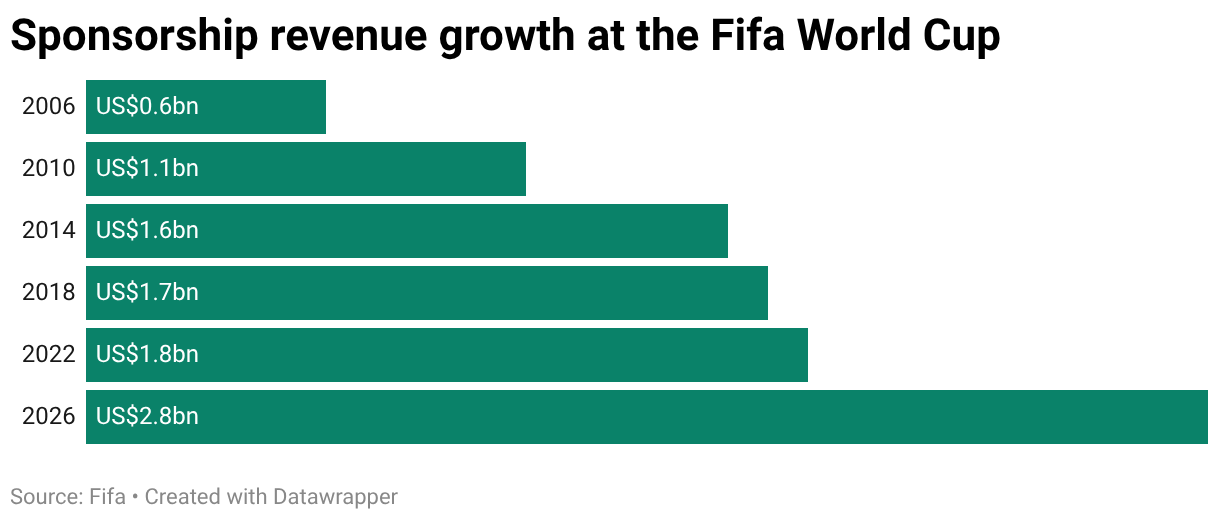
It has also created more revenue for Fifa itself, with soccer’s global governing body expecting to generate US$2.8 billion in sponsorship income from the 2026 World Cup, up from US$1.8 billion for Qatar 2022.
However, while the expansion of the tournament gives official partners a bigger commercial platform, it has introduced another layer of complexity that sponsors will be navigating for the first time.
“This is not just a bigger tournament,” says Ricardo Fort, who previously oversaw global sponsorships at World Cup partners Coca-Cola and Visa. “It is a tournament spread across three countries, multiple time zones, different regulatory environments, and very different consumer behaviours.
“A sponsor is no longer planning one event; it is effectively planning dozens of interconnected events. The brands that win will be the ones that avoid trying to activate everywhere equally. Scale is only an advantage if accompanied by strategic discipline.”
‘Buying the rights was the affordable part’
Fort believes one consequence of the World Cup expansion is that activation budgets will rise “significantly”. Some brands are reportedly paying as much as US$100 million simply to associate themselves with the competition but will be investing more on top of their rights fees to bring their partnerships to life.
That isn’t unusual for major international events like the World Cup and the Olympic Games. Even so, Fort suggests that a longer tournament – and the additional requirements it brings in areas like logistics, staffing, customer experiences and hospitality – has the potential to drive up costs.
“In some categories, activation spend could equal or exceed the sponsorship fee itself,” he notes. “For some brands, buying the rights was probably the most affordable part of their Fifa projects.”
In that context, sponsors will be thinking strategically about how and where they show up during the most geographically dispersed World Cup in history. Fort anticipates brands will allocate “disproportional resources” in major markets like Los Angeles, Miami and New York, which will stage the final on 18th July. It is also possible that partners will focus on the host cities with more matches and those where they already have a strong local presence.
Ross says BofA plans to activate “as broadly and deeply” as possible across all 100 US markets in which it operates – its financial centres are within reach of 80 per cent of the American population, he says – with additional activation layered on for host cities and the various base camp locations.
“There’s a national plan that everybody in the US is going to feel and see,” Ross adds. “And that’s where the focus is.”
Related posts


Agility, speed and real-time conversations
While the tournament naturally creates opportunities to engage with the millions of spectators expected to attend games and fan festivals staged by the North American co-hosts, global sponsors have also been investing in campaigns to reach fans around the world.
For example, consumer packaged goods firm Unilever is activating 35 brands across 120 markets for its World Cup sponsorship, representing the company’s largest sports partnership investment ever. Lynx alone is investing UK£5.4 million (US$7.2 million) in its UK campaign.
Retail activations are well underway, with limited-edition bottles and cans of products like Sure, Dove and Radox already filling shelves. Leaning heavily into social media, the programme will also see Unilever brands work with a network of 50,000 influencers and content creators, including athletes, fans, sportscasters, and fashion, lifestyle and beauty talent.
House of Fresh experiential spaces will appear in host cities Mexico City, New York and Miami, while 24/7 social media hubs have been set up in key markets like London and São Paulo. With fans set to rely on various media channels to keep up with a tournament spanning 13 different kick-off times, the approach is designed to ensure that Unilever’s brands are constantly part of a conversation that will be dominating feeds over the coming weeks.
“The operational challenges are how can we be agile, bring speed, and tap into real-time conversations?” says Afke Van de Klashorst, vice president of integrated brand experiences at Unilever. “Those are the things that are going to make this World Cup different to any other.”
Fifa has a bigger sponsorship portfolio for the 2026 World Cup, which also means more brands clamouring for attention (Image credit: Getty Images)
‘It can get overwhelming’
BofA and Unilever aren’t the only brands with big plans for this summer’s World Cup. The pair are two of 16 global sponsors, while there are also regional supporters and host city partners who will be looking to make themselves heard during the event.
There is rarely a shortage of noise during a World Cup, but it is likely to be even more pronounced during an edition where many of the games are being held in a country widely regarded as the centre of the sports marketing universe.
With Donald Trump now back in the White House, the political backdrop to the event is also different to when some sponsors signed their deals. Not unlike previous World Cups, the build-up to the tournament has been dominated by off-pitch storylines – ranging from Iran’s participation and soaring ticket prices to Trump’s immigration crackdown – that could distract from the tournament itself.
While that might be an ongoing concern for sponsors, Fort says global brands are more experienced in operating amid geopolitical tension than they were a decade ago. Ross, who is working on his fifth World Cup and his first with BofA after joining from Coca-Cola, acknowledges there are no guarantees, but is hopeful that the 2026 event follows a familiar pattern whereby public attention shifts once games are underway.
Either way, that combination of factors means brands are likely to face fierce competition for attention – and not just from other advertisers. As moments and trends emerge over the coming weeks, Ross believes the challenge for every sponsor is to resist the temptation to be “everything to everyone” once the World Cup begins.
“It’s hard to do that,” says Ross, who was speaking at SportsPro London. “You’ve got to focus on what you’re trying to achieve. Otherwise, it can get overwhelming and you could end up being noise in the wallpaper that surrounds some of these big events.”
As a non-endemic brand, Ross says BofA has identified its “swim lane”, using its sports partnerships to act as a convenor that provides access. For the World Cup, that means leaving behind a community soccer pitch in every US host city, contributing to its longer-term commitment alongside US Soccer to bring the game to every American school by 2030.
“If you say what you mean and you mean what you say, that’s one way to stand out from the clutter,” Ross adds.
According to Van de Klashorst, Unilever has similarly defined lanes for the various brands that it will be promoting during the tournament. Rexona, for example, owns performance under pressure, Dove drives conversations around confidence and participation, and Axe is associated with youth culture and participation.
That means that, when opportunities do arise during the tournament, there’s no doubt over which brand will own it.
“It’s about being very clear and disciplined on the role each of our brands plays within the ecosystem we’ve built,” says Van de Klashorst. “So when something happens that we want to respond to, it’s very clear which brand has the right to do that. A lot of preparation has gone into that.”
‘It’s a tricky line to walk’
That discipline will also extend to measurement, especially if the World Cup expansion has led to increased investment.
While Fort expects the noise and fragmented fan attention to put pressure on less experienced sponsors and those with lower budgets, he says every partner can be “ROI positive” if they focus on the objectives that matter most to their business – rather than vanity metrics like reach and impressions.
Ross says BofA will be tracking metrics like client favourability scores, prospect relationships and the number of schools reached through its Soccer in Schools programme. For Unilever, which has a five-year deal with Fifa also covering the Women’s World Cup, goals include driving desirability and deepening engagement with younger and more socially active audiences.
For all the opportunities created by expansion, then, the 2026 World Cup is encouraging sponsors to make sharper choices about where to invest and who they want to reach. Even if the challenges around the tournament have evolved, it seems the guiding principles remain the same.
“Remember, you are the marketing lead for your brand – not for Fifa or the sport of football,” says Ross. “That’s an easy distinction to get wrong.
“You should be borrowing the equity of the rights holder to drive your brand, not doing too much on behalf of the rights holder. It’s a tricky line to walk, especially when the magic of the Fifa World Cup is on.
“But the best brands understand that and know how to play in that space.”

Get your daily briefing of all the essential news across the sports industry with the SportsPro Daily Newsletter. Subscribe here.